The Client
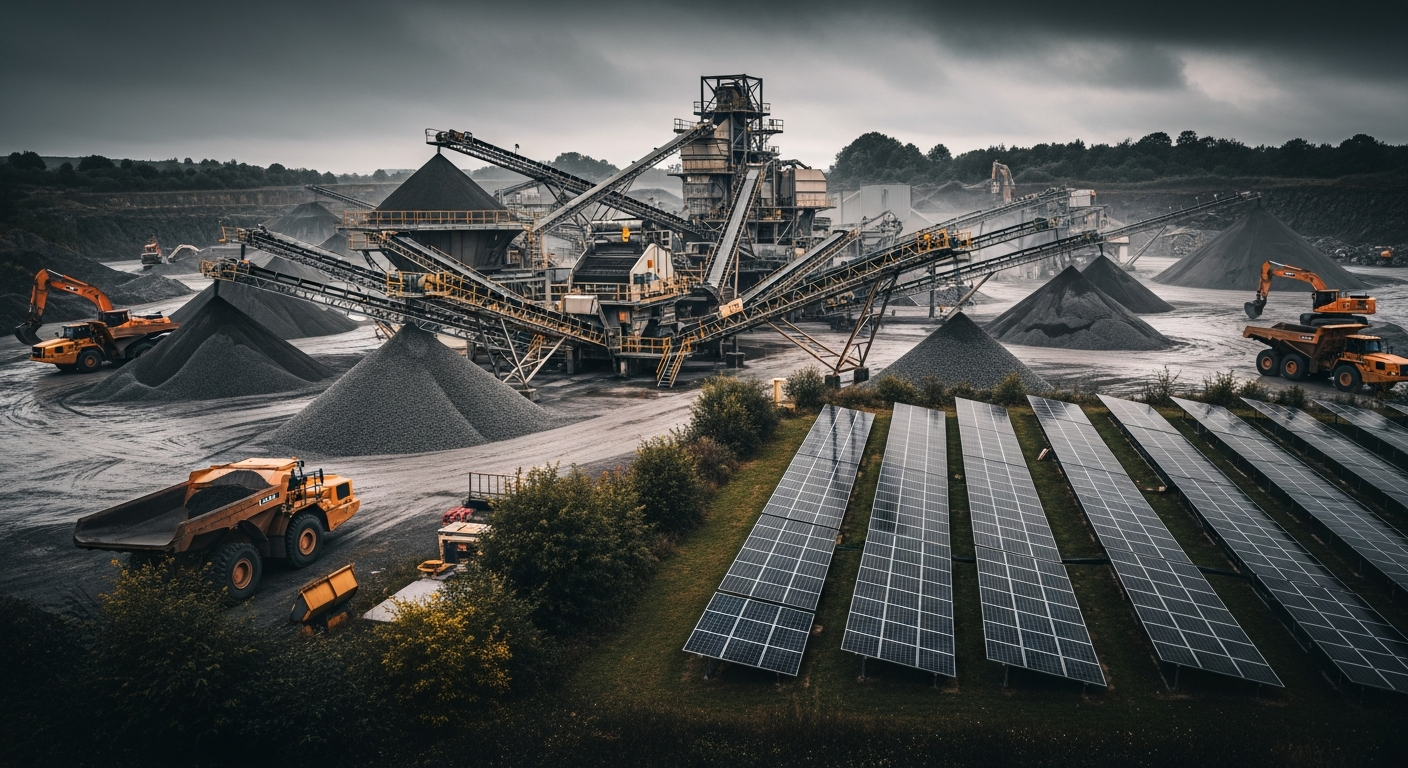
A large aggregates quarry in the Peak District, producing 1.5m tonnes of crushed stone per year. The site operates 24/7 with three crushing lines, each rated at 1.2MW. The quarry had a 3MVA grid connection, but the crushing demand was 3.6MW — meaning the site relied on diesel generators for 600kW of baseload power, plus all backup during grid outages.
The Challenge
The quarry's energy costs were £1.8m per year, with £420,000 spent on diesel fuel alone. The diesel generators were noisy, polluting, and required constant maintenance. The local grid was weak, and the utility could not upgrade the connection without a 3-year lead time and £2m in infrastructure costs.
The site had 12,000m² of unused land with a south-facing slope, ideal for ground-mount solar. The crushing process also generated significant waste heat (600kW) that was vented to atmosphere. The management wanted to reduce diesel use, improve reliability, and lower the site's carbon footprint.
The Skyline Approach
We started with a 12-month interval data analysis. The data revealed that the crushing demand was 3.6MW continuous, but the grid could only supply 3.0MW. The 600kW shortfall was covered by diesel generators running 8,000 hours per year. The waste heat from the crushing process was 600kW — exactly the same as the shortfall.
- Crushing demand 3.6MW, grid only 3.0MW — 600kW diesel gap
- Waste heat 600kW vented — potential for CHP heat recovery
- Solar-only offset 800kW daytime but left night diesel unchanged
- CHP + solar hybrid covered baseload and peak, eliminated diesel
We modelled three scenarios: solar-only, CHP-only, and hybrid. The CHP-only scenario would cover the full demand but left 12,000m² of land unused. The solar-only scenario offset 800kW during the day but left the night diesel unchanged. The hybrid scenario — CHP plus solar — eliminated the diesel entirely and used the land for solar.
The Solution
2.5MW CHP Unit
Natural gas cogeneration unit generating 2.5MW electricity and 2.8MW heat. The heat is used for aggregate drying and on-site space heating. The unit runs 8,000 hours per year at 82% total efficiency. Annual diesel displacement: 600kW × 8,000 hrs = 4,800MWh.
800kWp Solar Array
Ground-mount solar array on 12,000m² of south-facing slope. Generates 720MWh/year, offsetting 20% of the daytime crushing demand. The array is divided into 6 zones with independent inverters for fault tolerance.
The Results
| Metric | Before | After |
|---|---|---|
| Diesel consumption | 4,800 MWh/year | 720 MWh/year (-85%) |
| Grid import | 3,000 MWh/year | 2,280 MWh/year (-24%) |
| Total energy cost | £1,800,000 | £1,120,000 (-38%) |
| CO₂ emissions | 2,800 tonnes | 1,650 tonnes (-41%) |
| Generator maintenance | £85,000/year | £12,000/year (-86%) |
The Operational Impact
The quarry's operations manager reported that the most significant change was the elimination of the diesel noise. The CHP unit is housed in an acoustic enclosure and runs at 65dB — quieter than the crushing plant itself. The diesel generators, which ran continuously and were a source of complaints from nearby residents, now only start during grid outages.
The CHP heat recovery system also changed the site's operations. The waste heat from the crushing process was previously vented, but the CHP unit captures it and uses it for aggregate drying. This eliminated the need for a separate gas-fired dryer, saving an additional £45,000 per year.
The Technology-Agnostic Approach
The key to this project was matching the technology to the site's specific constraints. The grid was weak, so a grid-only solution was not possible. The waste heat was significant, so CHP was the obvious choice. The land was available, so solar was a natural addition. A battery would have been a poor fit — the load was steady, not peaky.
If you operate a heavy industrial site with a weak grid connection and significant waste heat, a CHP-plus-solar hybrid may be the right answer. We offer free feasibility studies that model your specific load profile and grid constraints.