Onsite Energy for the Public Sector
Schools, hospitals, leisure centres and council estates face binding carbon obligations alongside tight budgets. We deliver independent feasibility, low-carbon generation and the reporting needed to evidence progress.
Cutting carbon without overspending the budget
Public bodies must balance decarbonisation duties against constrained budgets and complex estates.
Carbon & reporting obligations
Statutory Net Zero commitments and reporting duties require measurable, evidenced reductions across the estate.
Budget constraints
Capital is limited and must be justified on both carbon and whole-life cost grounds, often through a business case.
Ageing, mixed estates
Diverse buildings and legacy heating systems make one-size-fits-all solutions inefficient and risky.
Funding complexity
Grant schemes are competitive and time-limited, with strict eligibility and evidence requirements.
Diverse buildings, one decarbonisation plan
- Ageing boilers and mixed building fabric across the estate
- Statutory carbon duties that demand evidenced, not estimated, cuts
- Capital that must be justified on whole-life cost and carbon
What shapes the energy brief
- Primary driver
- Carbon & ESG
- Estate type
- Mixed & ageing
- Best-fit assets
- Solar + heat pumps
- Key constraint
- Budget
statutory reporting obligations
schools, hospitals, council buildings
with EMS and reporting
whole-life cost business case
A measurable path to Net Zero
Statutory commitments require evidenced reductions, not estimates. A phased mix of generation, heat decarbonisation and controls can cut emissions year on year — and prove it for reporting.
Public sector estates carry a dual mandate: reduce carbon in line with statutory commitments while protecting hard-pressed operating budgets. Decarbonising heat, generating power onsite and managing demand intelligently can serve both goals at once — but only if the investment is targeted where it pays.
These estates are often diverse, spanning ageing buildings, mixed heating systems and varied occupancy patterns. That makes independent, vendor-neutral assessment especially valuable: it ensures capital goes to the measures with the strongest combined carbon and financial case, and that the results can be evidenced for reporting.
We work from each estate's consumption data to recommend a proportionate mix of generation, heat decarbonisation and controls, and to provide the board-ready reporting that public bodies need to demonstrate progress.
Decarbonisation pathway
A measurable path to Net Zero
Funding & grant support
Public bodies may be eligible for government decarbonisation funding. Schemes change over time and are competitive, so eligibility should always be confirmed against the current published criteria — but the most relevant routes are typically:
- Public Sector Decarbonisation Scheme (PSDS) — capital grants for heat decarbonisation and energy efficiency in public buildings, administered by Salix, subject to published eligibility and funding windows.
- Salix funding — interest-free or grant funding routes for qualifying public sector energy projects, where current schemes are open.
- We can structure feasibility and reporting to support a funding application, but cannot guarantee any award; eligibility and outcomes are determined by the scheme administrators.
Recommended technology stack
We prioritise measures that cut both carbon and running costs, supported by credible reporting.
Solar PV
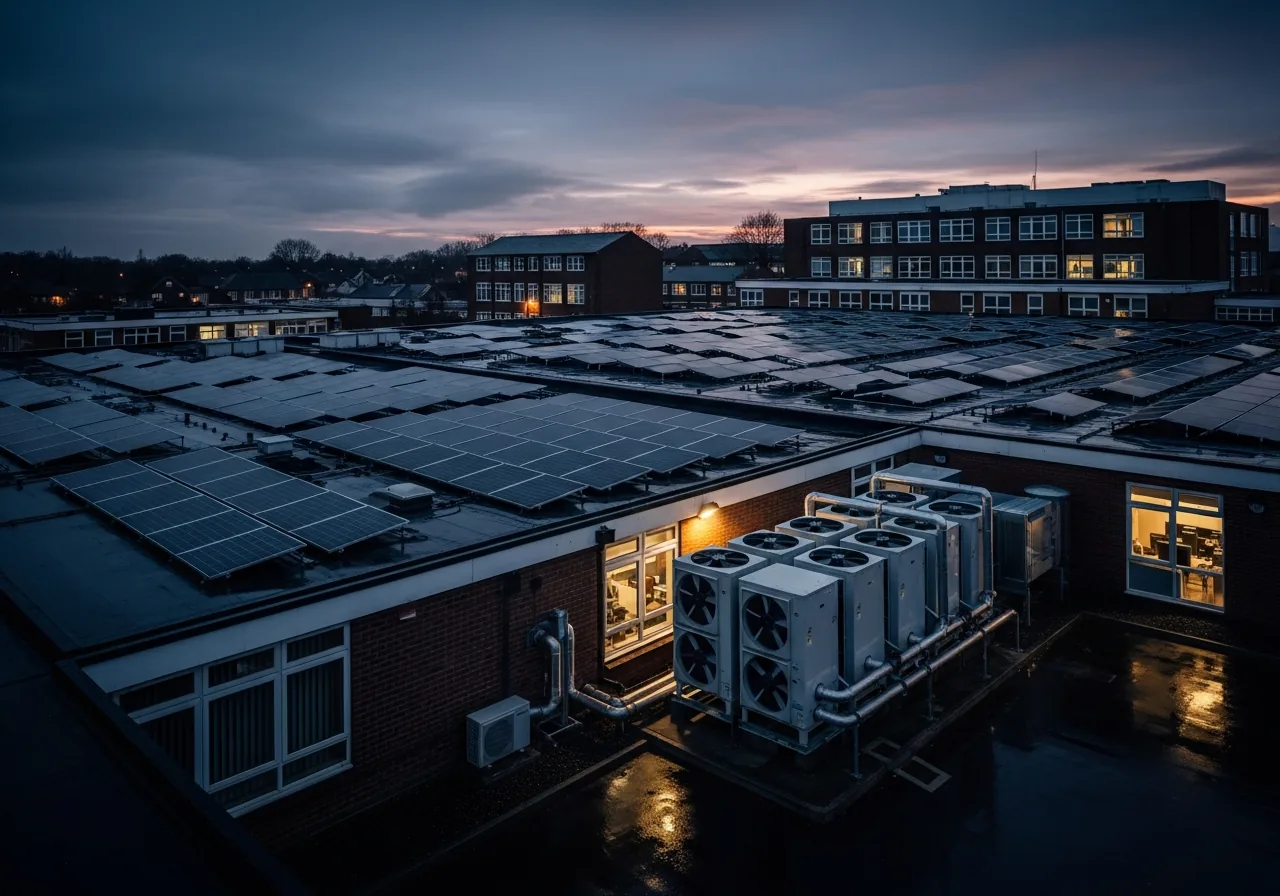
Generate low-carbon power onsite across school, hospital and estate rooftops to cut import and emissions.
Explore serviceHeat Pumps
Decarbonise heating by replacing ageing gas and oil boilers with efficient electric heat.
Explore serviceEMS & Smart Controls
Monitor and optimise across a diverse estate, and verify the savings that controls deliver.
Explore serviceEnergy Reporting & Compliance
Board-ready reporting and measurement & verification to evidence carbon progress for SECR and beyond.
Explore servicePublic Sector feasibility checklist
The more of the following we have to hand, the faster and sharper your feasibility study will be — and we can help fill any gaps. Every recommendation that follows is modelled on your data and subject to feasibility.
Common questions
Discuss your Public Sector site
Tell us about your site and we'll come back within one business day. Our engineers review your interval data and deliver a no-obligation feasibility study with technology recommendations, financial modelling and payback projections.
Ready to cut energy costs at your Public Sector site?
Book a free site assessment. Our engineers will evaluate your load profile and deliver a tailored feasibility study — no obligation.