Turn Onsite Assets into a Coordinated System
An Energy Management System and smart control layer that monitors, automates and optimises every asset — sequencing battery, solar, CHP and HVAC against live tariffs to cut cost and unlock demand-response revenue.
What You Need to Know
Installing low-carbon assets is only half the story. A battery, a solar array and a CHP unit each save money on their own, but their combined value is only realised when something intelligent decides — every half hour — what should charge, discharge, generate or shed against the live cost of power.
That is what an Energy Management System does. Skyline designs vendor-neutral, open-protocol control layers that sit across your existing metering and plant, giving you live visibility, automated optimisation, and the measurement and verification needed to prove savings for SECR and internal reporting.
Every asset, one coordinated system
An EMS sits across your metering and plant, sequencing battery, solar, CHP and HVAC against live signals — and feeding verified data into your reporting.
Inputs
Grid Import
Topped up only when needed
Solar PV
Daytime generation
CHP / CCHP
Power + recovered heat
Heat Pumps
Efficient heat & recovery
Integration & control
Micro-Substation
On-site distribution
Battery Storage
BESS — store & shift
EMS & Smart Controls
Optimises every flow
Outputs
Site Loads
Process, HVAC, EV, IT
Reporting Layer
Performance & ESG data
Why It Matters
Sites with good hardware often leave money on the table because the assets are run manually, in isolation, or against the wrong signals.
No live visibility
Energy data arrives weeks later on a bill, long after the expensive half-hours that caused it — making it impossible to manage demand in the moment.
Manual, siloed control
Battery, generation and HVAC each run on their own logic, with no coordination against tariffs, carbon intensity or onsite generation.
Missed flexibility revenue
Without automated dispatch, sites can't reliably participate in demand-side response or capacity markets and forgo a real income stream.
Unproven savings
When you can't measure and verify performance, it's impossible to show the board — or an auditor — what the investment actually delivered.
The Numbers That Matter
- Visibility
- Real-time
- Dispatch
- Automated
- Flexibility
- DSR-ready
- Integration
- Open-protocol
across all metered assets
against day-ahead tariffs
demand-side response capable
no single-vendor lock-in
Our Delivery Process
We build the control layer around your existing assets and metering, not a rip-and-replace. Every deployment is designed on open protocols so you keep control of your data and your supplier choice.
Audit & metering review
We map your existing metering, BMS/SCADA, and controllable assets, identifying where sub-metering or connectivity is needed for full visibility.
Integration design
We design an open-protocol integration (e.g. Modbus, BACnet, OCPP, MQTT) that brings battery, generation, EV charging and HVAC under a single control layer.
Control strategy
Dispatch rules are configured to optimise against day-ahead tariffs, peak-demand windows, onsite generation and, where you choose, grid-carbon intensity.
Monitoring & optimisation
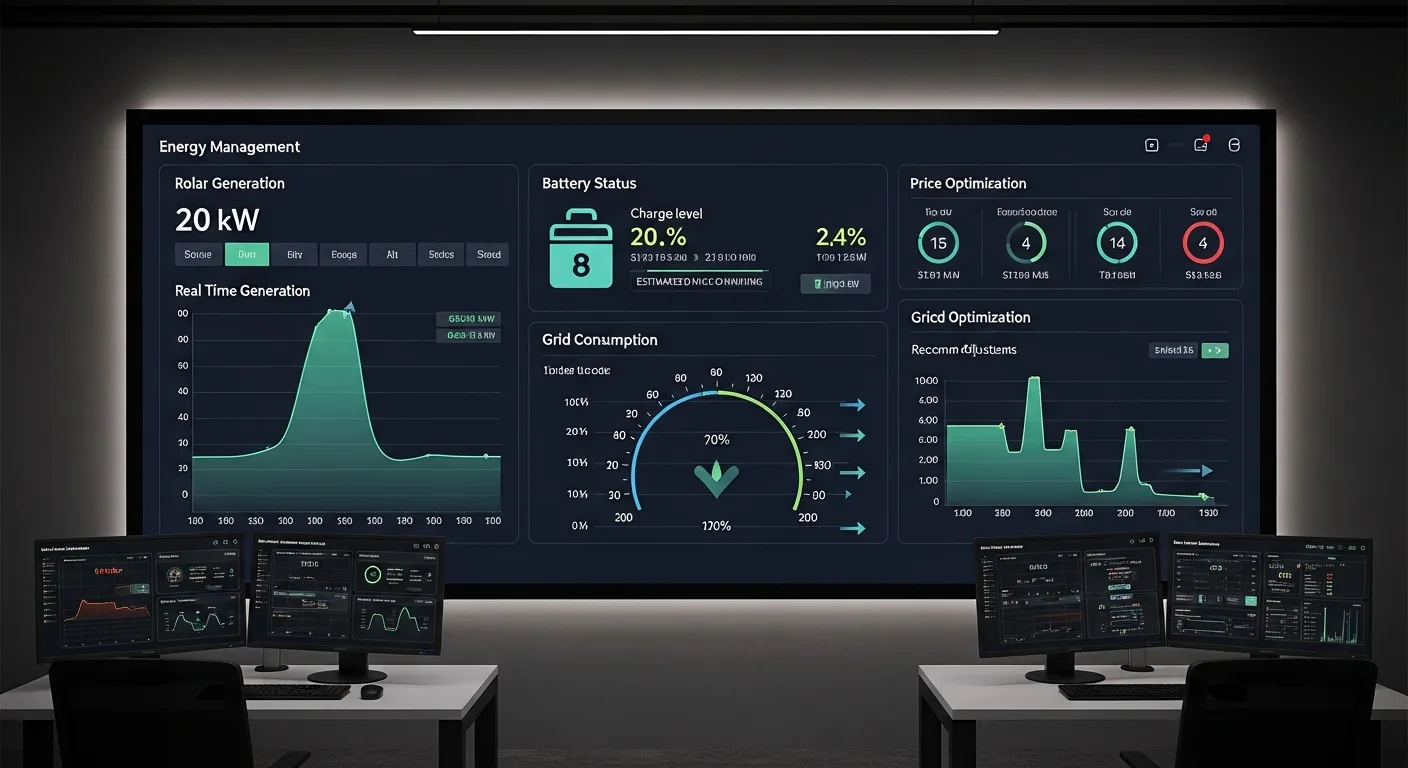
A live dashboard provides real-time visibility, alerting and reporting, with strategies refined over time as tariffs and site demand evolve.
What we need from you
The right control strategy depends on what's already on site. Sharing the following lets us design an integration that fits your estate.
- A list of metering points and any existing BMS, SCADA or sub-metering
- An inventory of controllable assets — battery, solar, CHP, HVAC, EV chargers
- Your current supply tariffs, including any time-of-use or capacity elements
- Network and connectivity details for the relevant plant and meters
- Your reporting needs — SECR, ISO 50001, internal KPIs or all of these
Technology-Agnostic. Engineer-Led.
Independent advice
We specify the right technology for your site, not the product we sell.
Whole-life economics
Every recommendation is modelled against your actual half-hourly interval data.
Complete delivery
Design, planning, installation, commissioning, and ongoing optimisation under one contract.
Measurable carbon savings
We quantify Scope 2 reductions for your SECR and ESG reporting.
Proven track record
Projects across manufacturing, food & beverage, logistics, and data centres across the UK.
Performance assurance
Where applicable, generation and savings are backed by contractual performance terms and manufacturer warranties.
Frequently Asked Questions
Free feasibility study
Book a free site assessment
Our engineers review your interval data and deliver a no-obligation feasibility study with technology recommendations, financial modelling, and payback projections.
Request a quote for EMS & Smart Controls
Tell us about your site and we'll get back to you within one business day with a tailored proposal.
Related Services
Battery Storage
An EMS is what makes a battery dispatch profitably against live tariff signals.
Learn moreEnergy Reporting
Feed verified EMS data straight into board-ready and compliance reporting.
Learn moreSolar PV
Coordinate generation, storage and demand to maximise self-consumption.
Learn moreCompare Technologies
See which assets are worth controlling first on your site.
Learn moreSectors We Serve
Warehouses & Logistics
Large roofs, fleet charging and heavy peak demand make logistics sites ideal for on-site generation and storage.
Explore sectorBakeries & Food Production
Constant thermal and refrigeration loads make food production a strong fit for cogeneration, storage and heat recovery.
Explore sectorPublic Sector
Estate-wide carbon targets and constrained capital budgets make funded, measurable energy projects a priority.
Explore sectorFurther reading
How Energy Management Systems Cut Commercial Costs
Ready to explore EMS & Smart Controls for your site?
Book a free site assessment. Our engineers will evaluate your load profile and deliver a tailored feasibility study.