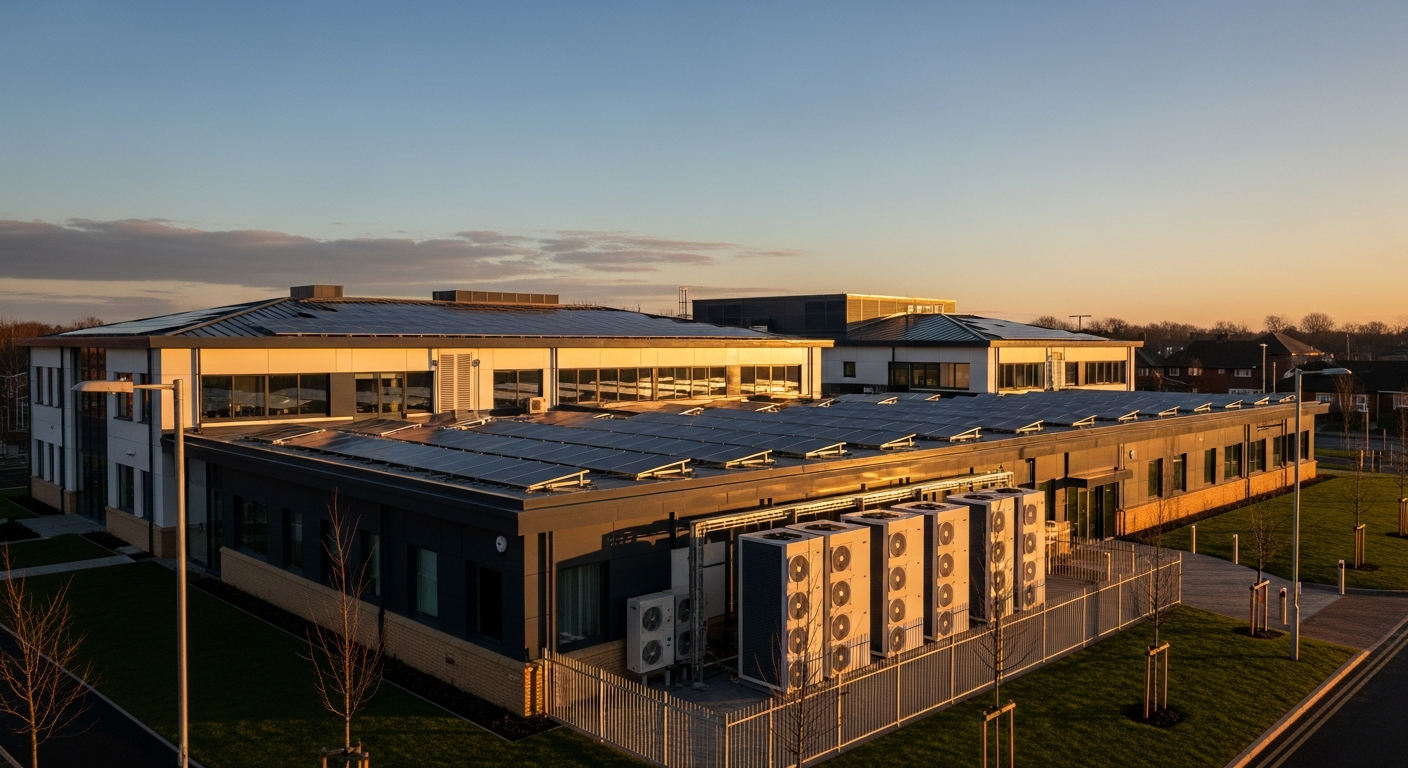
The Client
A 25,000m² public sector office complex in the North East, housing 1,200 staff across three departments. The building was constructed in 1998 with a gas boiler heating system and a D-rated EPC. Annual energy costs: £520,000, with £340,000 spent on heating and hot water. The government had mandated a net-zero target for all public buildings by 2035, and the site was a priority candidate.
The Challenge
The building's gas boiler system was 25 years old and operating at 68% efficiency. The heating bill was £340,000 per year, and the system required £45,000 in annual maintenance. The roof had 3,000m² of flat space with a south-facing orientation, ideal for solar. The building also had a 1.2MW electrical demand, with 60% driven by HVAC and lighting.
The public sector procurement process meant the project had to demonstrate clear value for money, with a payback period under 7 years and a measurable improvement in the EPC rating. The project also had to be completed without disrupting the building's operations — the staff could not be relocated.
The Skyline Approach
We started with a building energy audit and a 12-month interval data analysis. The data revealed that the heating demand was 2,800MWh per year, with a peak of 1.2MW during the winter mornings. The electrical demand was 4,800MWh per year, with a peak of 1.2MW during the summer afternoons (driven by cooling).
- Heating demand 2,800MWh/yr — heat pump with COP 3.5 would need 800MWh electricity
- Solar array 400kWp generates 360MWh/yr — offsetting 45% of heat pump electricity
- Heat pump displaces gas boiler entirely — £340,000/yr gas bill eliminated
- EPC rating improves from D to B due to renewable heating and solar generation
The key insight was that the heat pump would increase the electrical demand by 800MWh per year, but the solar array would offset 360MWh of that. The net increase in grid electricity was 440MWh, but the gas bill of £340,000 was eliminated. The net saving was £195,000 per year after accounting for the increased electricity cost.
The Solution
600kW Heat Pump System
Air-source heat pump array with 600kW total capacity and a COP of 3.5. The system provides heating and hot water for the entire building. Annual heat output: 2,800MWh. Annual electricity consumption: 800MWh. The system is installed in a modular configuration, with 6 units of 100kW each, providing N+1 redundancy.
400kWp Solar Array
Rooftop solar array on 3,000m² of flat roof. Generates 360MWh/year, offsetting 45% of the heat pump's electricity consumption. The array is connected to the building's LV distribution board, with export limited to zero (no grid export required).
The Results
| Metric | Before | After |
|---|---|---|
| Annual heating cost | £340,000 | £145,000 (-57%) |
| Annual gas consumption | 2,800 MWh | 0 MWh |
| Solar self-consumption | 0 | 360 MWh/year |
| EPC rating | D (78) | B (42) |
| CO₂ emissions | 720 tonnes | 280 tonnes (-61%) |
The Operational Impact
The building's facilities manager reported that the heat pump system was quieter than the old gas boiler (55dB vs 72dB) and provided more consistent heating. The old system had hot and cold spots, but the heat pump's variable-speed compressors maintained a steady temperature. The staff satisfaction score for heating improved from 62% to 89%.
The solar array was also visible from the staff car park, and the facilities team used it as a communication tool. The building's lobby display shows real-time solar generation, and the staff engagement score for sustainability improved from 45% to 78%. The project was featured in the local authority's annual report as a net-zero exemplar.
The Technology-Agnostic Approach
The key to this project was recognising that public sector buildings have unique constraints: procurement rules, EPC targets, and operational continuity. The heat pump was the best fit for the heating demand, the solar array offset the heat pump's electricity, and the combined system met the EPC B target. A battery would have been a poor fit — the load was steady and the site had no peak demand charges.
If you manage a public sector building with an aging heating system and a net-zero target, a heat pump-plus-solar system may be the right answer. We offer free feasibility studies that model your building's specific heat demand and roof area.